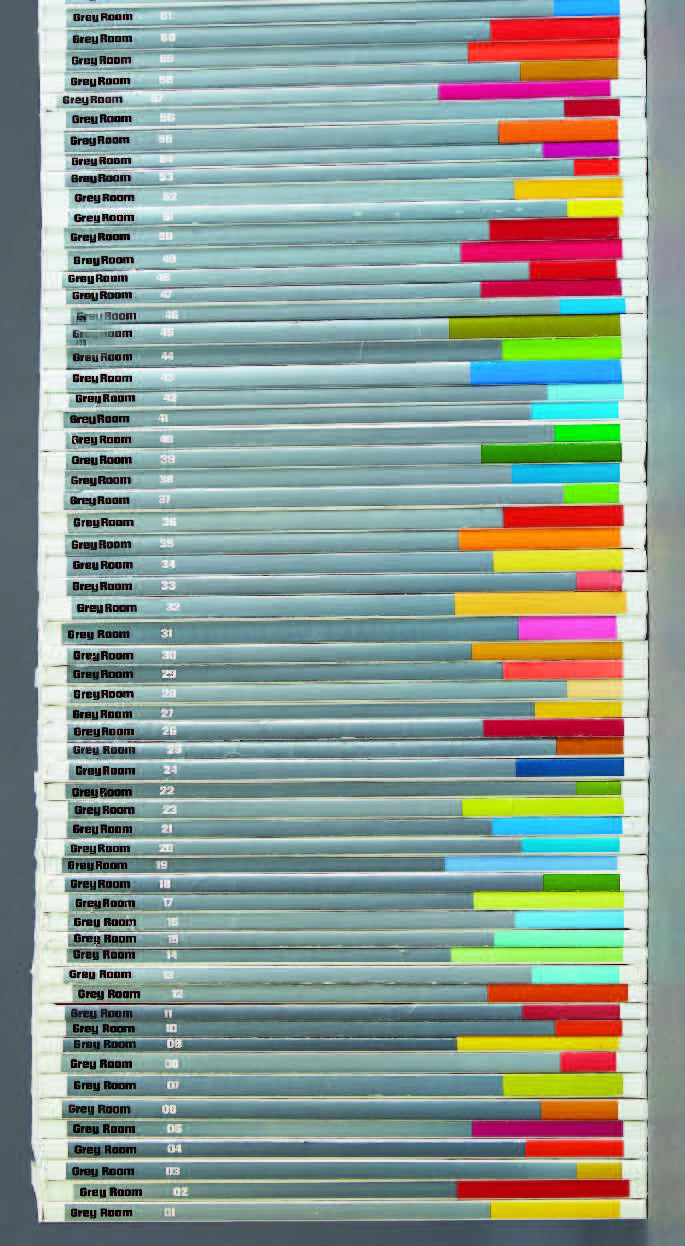
Photo falling—Word falling—Break through in grey room—Towers, open fire
When Branden Joseph, Reinhold Martin, and Felicity Scott founded Grey Room twenty-five years ago, they borrowed its title from a passage in William S. Burroughs’s novel The Ticket That Exploded (1962). As a new editorial group takes the helm, we revisit this foundational part of the journal’s identity to think about what it means to “break through in grey room” today.
Burroughs wrote these lines amid a period of postwar, Atomic Age tumult. For a number of years he resided in the so-called International Zone of Tangier, Morocco—a semi-lawless place where sovereign state power was indefinite, a city on the cusp of decolonial revolution. In Burroughs’s writings, it was fictionalized as the Interzone, “a place where the unknown past and the emergent future meet in a vibrating soundless hum.”1 No single national authority controlled the International Zone; its interstitial status was poised between a waning colonial Europe and the waxing Pax Americana, of which Burroughs was a certain sort of privileged scion. For decades, the Burroughs Corporation, a manufacturer of adding machines founded by the author’s grandfather, acted as a significant rival to (and occasional collaborator with) IBM. In the first half of the twentieth century, its computers aided astronomical calculations that guided U.S. sailors on the open sea and provided numerical and visual aids to bombing runs. Later on, in the second half of the twentieth century, it became a partner in the design of the U.S. military’s burgeoning command and control systems, including the spectacular multimedia SAGE (Surface to Air Ground Environment) aerial defense system and its successor, the North American Aerospace Defense Command (NORAD). The Burroughs Corporation’s business also thrived in the Global South, most notably under the patronage of the South African apartheid state. In this context, Burroughs’s invocation to “break through in grey room” perhaps envisioned the possibility of passing beyond the programmed and planetary control that made up his real and imagined inheritance.
At the turn of the millennium, the founding editors of Grey Room evoked Burroughs’s incantatory phrase in their call for rigorous and interdisciplinary essays on architecture, art, and media that grappled with the politics of modernity and postmodernity. They evoked Burroughs’s critique—and its reimagining by philosopher Gilles Deleuze as a “society of control”—at a moment when the consolidation of a global liberal order seemed ascendant and even hegemonic. While in some ways we now deal with the aftermath of those earlier certainties, in other ways our problems are very different. The social importance of technology now appears to be all-encompassing, but its political significance, once associated with state and bureaucratic control, has become both more overwhelming and more chaotic. The liberal dream of unconstrained movement, often limited to certain privileged actors such as Burroughs, has given way to violent efforts to divide the world into illiberal pockets and shelters, propped up by legal, technological, and military forces aided by ever-expanding databases. At the same time, the planetary crises of climate change and ecological devastation both reveal the globe as a unity while also accelerating the fragmenting political forces of the present. Global temperature has risen at least 0.5°C since Grey Room was launched.
Why Grey Room? The journal’s founding aim of concretizing and historicizing philosophical and sociological abstractions through object-oriented, materially grounded scholarship remains as vital as ever. Likewise, its initial goal to bridge the gap between academic fields fragmented by disciplinary logics is even more relevant today, as the humanities and social sciences are politically and institutionally weakened in the face of expanding political and financial threats. Grey Room provides a forum to investigate cross-cutting concepts such as “environmentality” or “liquidity,” where living histories of science and technology and of law, economics, and anthropology are mobilized in the analytical unpacking of seemingly inert entities like a mechanical gadget, a fading polaroid, a tidy line of code, a quaint garden, or a neatly framed painting.
Building on this legacy, we believe that the multidisciplinary orientation of Grey Room is distinctly equipped to address the challenges of the present and those that the coming years will undoubtedly deliver. The journal reaffirms its dedication to publishing bold theoretical interventions and experimental methodological investigations, spanning human and nonhuman perspectives, and engaging with artifactual critique and politically insistent materialities. It will continue the previous editors’ embrace of deeper timeframes and expanded political geographies. The editors seek to further deepen and multiply its inquiries into the racialized, gendered, and colonial logics of institutions and infrastructures and their cultural forms. As a collective, we aspire to reflect on how these histories impact our present-day disciplines, methods, and categories to repurpose and reimagine critique for the present.
A quarter of a century after its founding, the incoming editorial team aims to strengthen the journal’s enduring commitment to openness and risk-taking in scholarship, while remaining attentive to the inclusion of authors from around the world, especially those working in more precarious conditions. We know that, in the end, Grey Room is what its authors make of it and that its accomplishments to date are immeasurably indebted to them. Thanks to the previous editors’ past and ongoing commitments to the journal, we are honored to advance and extend the intellectual explorations already set into motion by our predecessors Zeynep Çelik Alexander, Lucia Allais, Karen Beckman, Eric de Bruyn, Noam M. Elcott, John Harwood, Byron Hamann, Matthew C. Hunter, Branden W. Joseph, Reinhold Martin, Tom McDonough, and Felicity D. Scott.
We thus continue:
“Photo falling—Word falling—Break through in grey room— Towers, open fire”